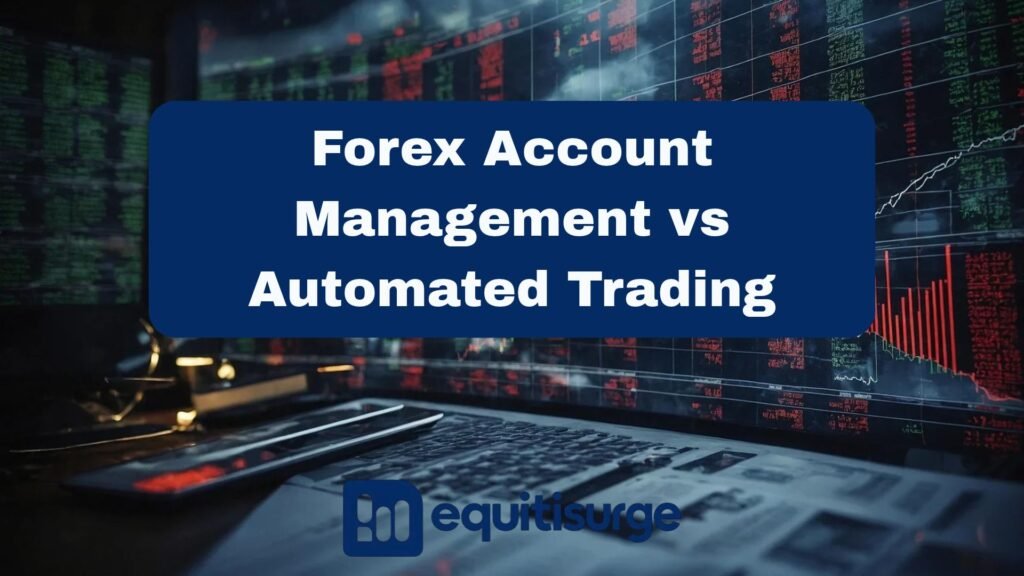
Forex Account Management vs Automated Trading is a choice between two ways of letting someone, or something, trade for you. With account management, a professional makes the trading decisions. With automated trading, software makes them. Both save you time. Both carry risk. And both work best when you understand them first.
This guide explains each option in plain words. You will learn how they work, where they differ, and what can go wrong. You will also see how to pick the one that fits your goals, your budget, and the time you have.
Here is the short version. If you want a person to make decisions, react to the news, and report back to you, look at account management. If you have clear rules and want a program to follow them without getting tired, look at automation. Many traders end up using a mix of both.
One note before we start. Forex trading uses leverage, and losses can come fast. Nothing here is financial advice. Treat this article as a map, not a promise.
What Is Forex Account Management?
Forex account management means a trader or a firm trades your account for you. You still own the money. You do not hand it over to anyone.
Here is how it usually works. You open an account in your own name with a regulated broker. You fund it yourself. Then you sign a Limited Power of Attorney, often called an LPOA. This paper lets the manager place trades. It does not let the manager withdraw your money.
That last point matters. In a safe setup, the manager can only trade. You alone can deposit and withdraw. You can also log in at any time and see every trade.
A good manager does more than click buttons. They choose position sizes, set stop-losses, watch the news and decide when to stay out of the market. Some managers use tools and algorithms to help. The key is that a person stays accountable for the decisions.
Fees differ from one provider to another. Many charge a performance fee. A fair version uses a High-Water Mark. This means you only pay on new profit, not on profit that merely wins back an earlier loss.
EquitiSurge is one example of this model. It manages trades inside the client’s own regulated broker account through an LPOA, and it states that it never holds client deposits. We cover its details in the listing below.
What Is Automated Trading?
Automated trading uses software to trade by rules. You, or a developer, write the rules first. Then the program watches the market and places orders when those rules are met. It does not need your confirmation.
In forex, the most common tool is the Expert Advisor, or EA. It is a program that runs on platforms such as MetaTrader 4 and MetaTrader 5. People also call these programs forex robots or trading bots. You can buy one, or build your own if you can code. Most still need you to set them up and adjust their settings.
There are also hands-off forms. Copy trading links your account to another trader’s account, so yours follows what theirs does. A MAM account works in a similar way: orders placed on a master account are mirrored to the linked accounts.
Why do people like automation? It has clear strengths:
- It follows the same rule every time.
- It can watch many markets without breaks.
- It can react in a fraction of a second.
- It keeps detailed logs of what it did.
- Its rules can be backtested on past data.
But a robot is only as good as its rules. It repeats a bad rule just as faithfully as a good one. It also cannot understand a surprise, such as an unplanned central bank statement, unless someone built that case into the code.
Forex Account Management vs Automated Trading: Key Differences
The biggest difference is who makes the decisions. The table below shows the rest.
| Factor | Forex account management | Automated trading |
|---|---|---|
| Who decides | A trader or a team | Software following coded rules |
| Adaptability | Can pause or change course for news and odd market conditions | Follows its rules until someone edits them |
| Consistency | Depends on the manager’s discipline | Repeats the rule exactly, mistakes included |
| Your workload | Low: you review reports | Medium to high: setup, testing and monitoring (lower with copy trading) |
| How you check it | A verified track record and live account access | Backtests, paper trading and live logs |
| Main risk | Poor judgment, weak risk control, unverified claims | Bad code, bad data, outages and overfitting |
| Typical cost | Often a performance fee, sometimes a minimum deposit | Software or EA price, data and hosting |
Let us look at three of these more closely.
Adaptability: Markets do odd things. A spread can widen, a news release can move price in seconds, or a platform can glitch. A human manager can step aside and wait. A robot keeps going unless you built a rule that tells it to stop.
Consistency: A robot never feels tired or nervous. That is a real edge. But a manager with a written plan and strict risk limits can also be very consistent. What matters is the discipline behind the process.
Emotion: You will often hear that automation removes emotion. That is only partly true. A program has no fear. But you can still make emotional choices around it. You might raise your risk after a loss, tweak the settings after a bad week, or switch it off at the worst time.
The Risks of Each Approach
Neither option is safe by default. Each one fails in its own way.
Risks of automated trading: The biggest dangers are technical. Data can be wrong. A connection can drop. An order can be rejected while the program thinks it was filled. A famous case is Knight Capital. On August 1, 2012, a wrongly deployed system sent millions of bad orders in about 45 minutes, and the firm lost more than $460 million, according to the US SEC. That was a control failure, not a news surprise.
Backtests can also fool you. If you keep tuning a robot until the past looks perfect, it may fail on new data. This is called overfitting. A good backtest is a start, not proof.
Risks of account management: Here the danger is the manager. Poor judgment, loose risk limits, or a track record you cannot verify can all hurt you. You also depend on the manager staying disciplined when the market turns.
US regulators have also issued warnings. The CFTC says automation and AI cannot predict sudden market shifts, and it calls guaranteed-return claims a red flag.
What to check before you trust either one:
- Where your money sits: It should stay in your own account at a regulated broker.
- What the provider can do: Trading rights only. Never withdrawal rights.
- Proof of results: Look for independent verification, such as Myfxbook, and check that the account shows open losses, not just closed wins.
- Risk limits: Ask about stop-losses, position sizes and maximum drawdown.
- Fees: Know what you pay, when you pay it, and on what.
- Exit rules: You should be able to switch the service off and take your money out at any time.
A Third Option: The Hybrid Approach
You do not have to pick one side. A hybrid setup splits the work. Software handles the repeat tasks. A person handles the judgment calls.
For example, a tool can scan for setups, work out your position size and send an alert. Then a trader checks the news and the market before approving the order. The rules about maximum risk and stop-losses stay fixed and are never improvised.
This works well because each side covers the other’s weakness. The software keeps the process steady. The human keeps an eye on the things the code did not expect. The key is to write down who does what, so nothing falls between the two.
How to Choose
Ask yourself these questions.
- How much time do you have? If you have little, a managed account or copy trading takes the least effort.
- Can you write your strategy as exact rules? If yes, automation is possible. If your method relies on feel, it is not ready to automate.
- Can you watch a system and fix problems? A robot running alone needs a recovery plan.
- Do you want to learn or to delegate? Learners often do better with manual trading or a hybrid. Busy investors often prefer delegation.
- How much can you put in? Many managers set a minimum deposit. Robots have their own costs for software, data and hosting.
Options to Consider: Overview, Features and Prices
Here are four options, from hands-off to hands-on. Details come from each provider’s own pages, so check them again before you commit.
1. EquitiSurge (Forex Account Management)
Overview. EquitiSurge is a professional forex account management service. Its team trades inside your own regulated broker account through an LPOA, and it states that it never holds client deposits. It is the only option on this list where a professional takes over the trading while your money stays in your name. EquitiSurge reports a 10-year annualized return of 21.4% and says its track record is certified through Myfxbook. Past results do not guarantee future results, so read the live data yourself. The site also lists an AI trading bot, stock trading and fund management.
Features:
- Trading rights only. You keep control of all deposits and withdrawals.
- Funds are held at regulated partner brokers, not pooled with others.
- Strict position sizing and drawdown controls on every trade.
- Live market monitoring 24 hours a day, 5 days a week.
- Performance and trade history visible in your own broker account.
- A simple start: a consultation, then account setup and funding, then LPOA sign-off. If you already have a funded broker account, you can connect it directly.
- A Telegram community for market insights and trading education.
Price list:
| Item | Details |
|---|---|
| Standard managed account | From $5,000 USD |
| Institutional tier | From $50,000 USD, with dedicated portfolio management |
| Performance fee | High-Water Mark basis, charged on net profits only, collected by the broker at the end of each billing cycle |
| Custody | None. Funds stay in your own broker account |
2. RelicusRoad Pro (Manual Trading Tools)
Overview: RelicusRoad is an indicator suite for traders who place their own orders. It draws key levels and trends on your chart so you can focus on the trade. It supports manual and hybrid styles, but it does not trade for you.
Features: Support and resistance zones, order blocks, trendlines, signal lines, daily pivots, session markers and multi-timeframe views. It works on MT4, MT5 and TradingView.
Price list:
| Product | Price |
|---|---|
| RelicusRoad Pro (full suite) | $57 per month, with a 7-day free trial |
| Trendlines | $49 |
| Dynamic Circles | $39 |
| Signal Line | $39 |
| SuperTrend | $29 |
3. LuxAlgo (Charting, Testing and Rule Building)
Overview: LuxAlgo offers a charting platform called Vela. It suits traders who want to test their rules before using real money, whether they trade by hand or plan to automate.
Features: Backtesting, a coding agent named Quant that helps turn written rules into code, alerts, a trade journal, and broker connections.
Price: It offers a free $100,000 paper trading account. Paid plans are listed on its pricing page.
4. AvaTrade (Broker Platforms)
Overview: AvaTrade is a broker. It says its platforms support manual, automated and hybrid strategies, so you can try more than one style under one roof.
Features: Automated risk tools such as stop-loss, take-profit and trailing stops, plus a demo account for practice.
Price: Prices are not listed in the material we reviewed. It offers a free demo account, and trading costs depend on the account and product, so check its fee pages.
Final Thoughts
The Forex Account Management vs Automated Trading question has no single right answer. It depends on your time, your skills and how much control you want. Automation gives you speed and repeatable rules, but you must build, test and watch it. Account management gives you human judgment and less daily work, but you must choose the manager with care.
Whichever way you lean, the safety checks stay the same. Keep your funds in your own regulated account. Give out trading rights only. Ask for proof you can verify. Understand the fees. And never trust a promise of guaranteed returns.
If you would rather have a professional trade for you while your money stays in your own account, EquitiSurge is a good place to start. You can book a consultation, review its verified track record, and ask your questions before you put in a single dollar.
Trading leveraged products can lead to fast losses. This article is for education only and is not financial advice.


[…] The investor establishes an account in their own legal name with a regulated broker, granting trade execution authority to the automated quantitative engine via a Limited Power of Attorney (LPOA) or financial API […]