What are forex managed accounts?
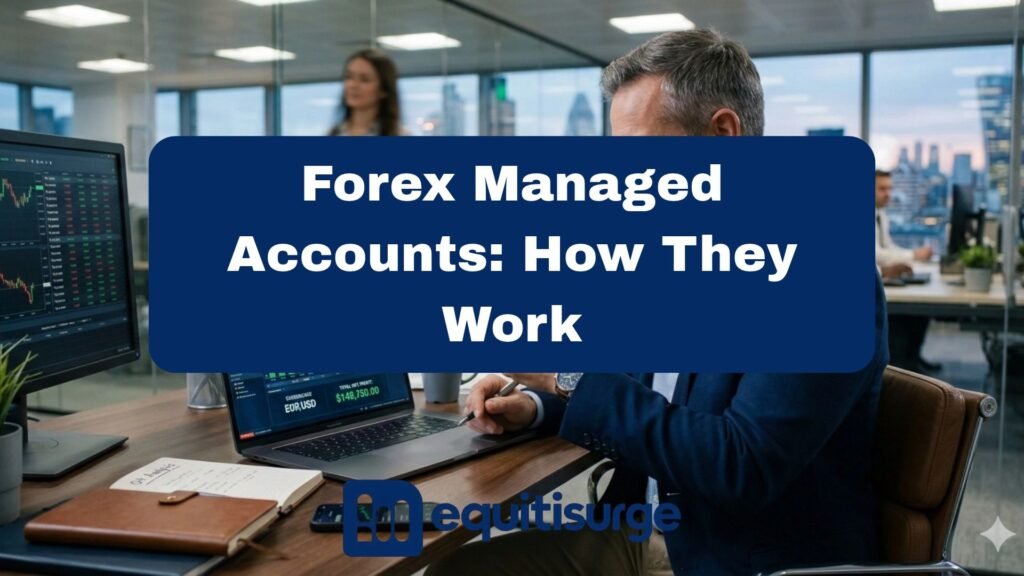
A forex managed account is a brokerage account in your name that a professional trades for you. You sign an authorization so the manager can place trades, but the money stays with your broker, and you keep control of deposits and withdrawals. The manager is usually paid a share of the profits.
That is the whole idea in four sentences. The rest of this article is about the details that separate a sound setup from a risky one.
How a managed forex account works
Most arrangements follow the same four moves:
- You open a broker account in your own name. Choose a regulated broker that allows third-party trading authority. Your deposit goes to the broker, never to the manager.
- You sign a limited power of attorney (LPOA). This document lets the manager place and close trades. It does not let them withdraw or transfer your funds.
- The manager trades the account. Strategy and risk limits follow the mandate you agreed on.
- You watch everything. You can log in, see open positions, read the trade history, and revoke the authority if you lose confidence.
Pooled products work a little differently, and we get to those below. But the core idea, trading rights without custody, is what protects you.
What the LPOA allows and what it blocks
A properly drafted limited power of attorney (LPOA) is the single most important safety feature in the whole arrangement. So read it like a contract, because it is one.
What a manager can usually do:
- Open and close trades
- Set stop-loss and take-profit levels
- Adjust position size within the agreed mandate
- View account activity and balances
What a manager should never be able to do:
- Withdraw money or move it to any other account
- Change your account ownership or contact details
Check two more things in the wording. First, can you revoke the authority at any time, and with what notice? Second, does the agreement mention any fee or penalty on termination? Better to find out before you sign than after.
Types of managed accounts: individual, PAMM and MAM
Not every managed product is built the same way. Here is how the common structures compare.
| Structure | How it works | Typical entry level | Best suited to |
|---|---|---|---|
| Individual managed account | A dedicated account in your name, traded by the manager under an LPOA | Often $10,000 to $50,000 or more, set by the manager | Investors who want tailored risk and full visibility |
| PAMM | Investor funds share one master account, and profit and loss are split by percentage | Often a few hundred dollars and up | Smaller budgets that want simplicity |
| MAM | The manager controls many separate sub-accounts and allocates by lot size or percentage | Varies, and usually higher than PAMM | Investors who want their own account with flexible allocation |
| Copy trading | You mirror a strategy provider’s trades automatically | Often a few hundred dollars | Self-directed investors who like to pick and switch providers |
Entry levels vary by broker and manager, so treat the table as a rough guide rather than a price list.
PAMM and MAM accounts both rely on a master account that the manager controls, yet they treat your money differently. In a PAMM, funds are pooled, so every investor shares one result. In a MAM, each investor keeps a separate sub-account, which means the manager can scale trade sizes to your balance and your risk appetite.
Copy trading vs managed accounts: what is the real difference?
People mix these up all the time. In both cases someone else’s trades land in your account. The difference lies in who answers to you and how much say you get.
- Relationship. Copy trading is a self-service marketplace where you pick providers yourself. A managed account is a service agreement with a named manager.
- Accountability. Copy providers are often anonymous retail traders with no duty of care to followers. A regulated manager works under written terms.
- Risk control. In copy trading you set your own stop-outs and allocation. In a managed account the manager runs risk against a mandate you both signed.
- Cost and entry. Copy trading usually asks for less money up front. Managed accounts tend to carry higher entry levels and a profit-based fee.
Neither route is better for everyone. The copy trading vs managed accounts question really comes down to how hands-on you want to be. If you enjoy selecting and monitoring providers, copy trading may suit you. If you want a professional relationship with written terms, a managed account fits better.
What managed accounts cost: fees explained
The most common structure is a performance fee and profit share, usually in the range of 20% to 35% of net new profits. Some managers add a management fee of around 1% to 2% a year, charged whether or not they make money. Always ask which model you are signing up for.
The term to look for is the high-water mark. It means the manager only earns a fee when your account reaches a new peak. Here is a simple example, ignoring the fee itself to keep the maths clean.
You invest $20,000, and the manager charges 25%.
- Month one: the account finishes at $22,000. The fee is 25% of the $2,000 gain, so $500.
- Month two: the account slips to $21,000. No fee, because you are below the peak.
- Month three: the account climbs to $22,500. The fee applies only to the $500 above the old $22,000 peak, so $125.
Without a high-water mark, the manager could have charged 25% of the full $1,500 bounce, which is $375. Same account, same results, a very different bill.
Also ask about costs that sit outside the headline fee: spreads, commissions, swaps, and early-withdrawal penalties in some pooled products. Get the full fee schedule in writing.
Minimum investment: what to expect
The minimum investment depends more on the structure than on the brand. Pooled and copy products often start from a few hundred dollars. Individually managed accounts usually ask for ten thousand dollars or more, and some institutional tiers go well past fifty thousand.
A higher threshold is not proof of quality. It does tell you the manager is set up to give each client dedicated attention, which costs more to run.
The honest part: risks of forex managed accounts
Nobody should sell you managed forex without talking about risk. So here it is.
- Market risk. Leveraged currency trading is hard. In ESMA’s analysis of broker disclosures, between 74% and 89% of retail CFD accounts lost money. A professional manager improves your odds of disciplined execution, but leverage cuts both ways for them too.
- Drawdown risk. Some strategies win small for a long time and then lose big in one bad week. Grid and martingale styles are famous for this.
- Fraud risk. The CFTC warns that most scams involve unregistered people and firms, and that many frauds start on social media. Registration does not guarantee honesty, but it is a basic filter.
- Fee drag. A 25% performance fee on a mediocre year can leave you with very little. Run the numbers before you commit.
And one more point that belongs on every page about this topic: past performance does not promise future results. Not ours, not anyone’s.
How to choose a forex money manager
Use this checklist before you sign anything.
- Check regulation on two levels. Look at the broker holding your money and at the manager. In the US, search the manager on the CFTC check page and the NFA BASIC database. In the UK, use the FCA register. In Australia, use ASIC’s register. Elsewhere, find your local regulator.
- Demand a verified track record. Myfxbook and similar platforms connect to the trading account through a read-only investor password, so the numbers cannot be edited by hand. Look for years of history rather than months, a decent number of trades, and an equity curve that matches the balance. A wide gap between equity and balance can mean losing trades are being left open.
- Read the drawdown, not just the return. A 40% annual gain with a 35% drawdown is a very different product from a 15% gain with a 5% drawdown. Ask what the worst peak-to-trough fall was and how long recovery took.
- Read the LPOA wording. Trading authority only, revocable, no withdrawal rights. Walk away from any forex money manager who asks you to wire funds to a personal or company bank account.
- Understand every fee. Confirm the high-water mark, the billing cycle and the termination terms. If you are weighing PAMM and MAM accounts, also ask how losses are shared and who can see other investors’ data.
- Test communication. How often will you get reports, who answers your emails, and how fast? You will learn a lot from the first two weeks of replies.
Watch for these red flags:
- Guaranteed or fixed monthly returns
- Pressure to deposit quickly because a “window is closing”
- A track record you cannot inspect live
- A manager or broker you cannot find on any regulator’s register
Where EquitiSurge fits
We built EquitiSurge around the checklist above. Here is how our forex account management service works.
Your money stays yours. Funds sit in an account in your name at a tier-1 regulated partner broker, such as Pepperstone or Hantec Markets. We do not hold deposits. The LPOA lets our systems trade, and that is all it does, so withdrawals remain in your hands. You can read more on our forex fund management page.
The approach is systematic. Rules decide entries, position sizes are fixed, and we monitor the market 24 hours a day, five days a week. The flagship strategy is a G10 mean-reversion model built for capital preservation, with drawdown controls on every trade.
The fee follows the high-water mark. We earn on new profit only. Funding starts at $5,000 for standard managed accounts and $50,000 for institutional-tier accounts with dedicated portfolio management.
You can check the proof yourself. Our live accounts are linked to Myfxbook, and the Portfolio page shows balances, equity and profit, with investor logins available on request. Our verified track record is there to be inspected, not admired. Please inspect it.
Getting started is simple. It begins with a confidential consultation to match a strategy to your goals. After that, you open and fund an account in your own name at a partner broker, then sign the LPOA directly with the broker. Already have a funded account at one of our partners? You can connect it and skip the setup.
Ready to talk it through? Book a consultation or view our verified proofs first. Either way, you will see exactly what you are signing up for.
Bottom line
Forex managed accounts suit people who have capital, little spare time, and no wish to trade the markets themselves. Insist on a few basics: an account in your name, a regulated broker, an LPOA that allows trading only, a verified track record, and fees charged on new profit. Skip anyone who cannot meet those.
If you would like to see how a managed forex account built on those rules looks in practice, talk to the EquitiSurge team.
Frequently asked questions
Can a forex money manager withdraw my money?
Not under a properly structured LPOA at a regulated broker. The authority covers trading only, and deposits and withdrawals stay with you. The exception is a scam, where the “manager” asks you to send money to their own account. Never do that.
What is the difference between PAMM and MAM?
In a PAMM, investors share one pooled master account and split results by percentage. In a MAM, each investor holds a separate sub-account, and the manager scales trades to each balance. A MAM usually offers more flexibility, while a PAMM is usually simpler and cheaper to set up.
Are managed accounts regulated?
The broker holding your funds should be regulated by a recognised authority. The manager’s own registration depends on where they operate. In the US, advisers of this kind generally need CFTC registration and NFA membership, which you can check on NFA BASIC. Registration is a filter, not a guarantee.
How much can I earn?
Nobody can promise a number, and you should distrust anyone who does. Judge a manager by drawdown-adjusted results over a long period, not by a single hot month.
Is a managed account better than copy trading?
Not automatically. Copy trading suits people who like to choose and monitor providers themselves and want a lower entry level. A managed account suits people who want a written agreement, a named manager and risk run against a mandate. Pick the one that matches how hands-on you want to be.
Can I leave a managed forex account whenever I want?
With an LPOA you can revoke the manager’s authority and close positions yourself. Read the termination clause first, especially with pooled products, where lock-ups and early-withdrawal penalties are more common.
What happens if the manager stops trading or disappears?
Your money is in your own broker account, so you can revoke the LPOA, close open positions, and withdraw. That is a big reason to insist on a non-custodial setup.




[…] is why the high-water mark (HWM) is an important feature when evaluating managed forex accounts. It links manager compensation to genuine new performance rather than temporary […]
[…] in currency markets without accepting unnecessary exposure. Nevertheless, even carefully managed forex accounts remain exposed to market volatility, liquidity changes, and unexpected economic […]
[…] Forex managed accounts provide investors with access to professional currency trading without requiring them to execute every trade personally. […]